Modicon Quantum and the Evolution Toward Software-Defined Automation
Why This Transition Matters Now
Industrial operators are balancing two realities: proven Modicon Quantum installations still support important processes, while software-defined automation is changing how future control systems are engineered. The practical question is not whether experience built around Quantum has value, but how plants can preserve operational knowledge while moving toward more open, connected and maintainable architectures.
What Modicon Quantum Established
Modicon Quantum became a familiar programmable automation platform in process and infrastructure environments where deterministic control, remote I/O and resilient communications were essential. Modules such as the 140NOE77111 connected Quantum systems to Ethernet TCP/IP and FactoryCast services. That installed base represents more than hardware: it contains validated application logic, operating procedures and engineering decisions developed over years of production.
Who Faces the Modernization Decision
The decision primarily affects plant owners, controls engineers, maintenance teams and system integrators responsible for long-life assets. They must manage component availability, cybersecurity expectations and demand for production data without introducing unnecessary shutdown risk. Schneider Electric’s modernization material positions Modicon M580 as a migration path for Quantum applications and identifies tools and architectures intended to help control cost, technical risk and the pace of change.
Where Software-Defined Automation Changes the Model
The next architectural step separates automation applications more clearly from a single hardware target. Schneider Electric describes EcoStruxure Automation Expert as a software-defined automation platform based on IEC 61499, with controller choices that include Soft dPAC, high-availability Soft dPAC, Modicon M580 dPAC and other distributed controllers. This approach supports reusable software components and allows control functions to be deployed across suitable computing resources within an engineered system.
How Data Moves Closer to the Field
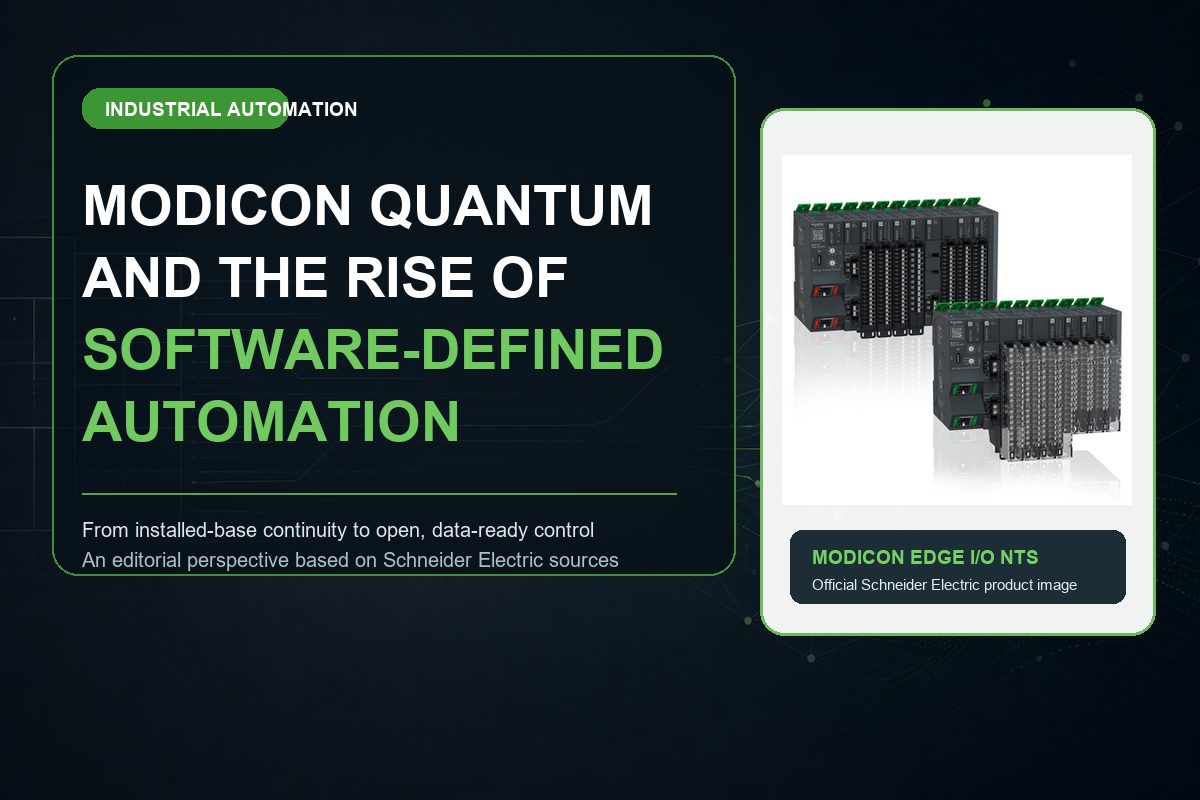
Modicon Edge I/O NTS illustrates how the field layer is also evolving. Schneider Electric presents it as a distributed IP20 I/O system for data aggregation, supporting Modbus TCP, EtherNet/IP and an internal bus based on OPC UA over TSN. Integrated diagnostics, hot-swap capability and cybersecurity functions are designed to improve availability while making operational data more accessible to control, maintenance and analytics applications.
When a Phased Approach Makes Sense
Modernization should begin when lifecycle exposure, security requirements or production objectives justify the work—not simply because a newer platform exists. Schneider Electric documents migration routes from Quantum to M340 or M580 and describes the 140CRA31908 adapter within Quantum S908 modernization architectures. A phased project can start with asset and firmware records, application backups, network assessment and spare-part planning before any controller or remote-I/O conversion is scheduled.
1 · Document
Record Quantum CPUs, power supplies, network modules, racks, I/O references, firmware and field connections before defining scope.
2 · Bridge
Use Schneider Electric migration guidance to preserve proven logic and remote-I/O investment while moving in controlled stages.
3 · Evolve
Evaluate M580, distributed PACs and software-defined control where openness, data access or lifecycle value supports the business case.
Why Quantum Still Belongs in the Conversation
Quantum and software-defined automation are not opposing stories. Quantum explains why continuity, predictable control and careful lifecycle management matter; the newer model extends those priorities with portability, open communications and data-ready architectures. The strongest modernization plan therefore starts with the real installed system, identifies what must remain stable, and changes only what delivers measurable gains in supportability, cybersecurity, engineering efficiency or plant performance.
Relevant Models from the Weekly Product Lists
| Model | Role | Model | Role |
|---|---|---|---|
| 140CPU31110 | Quantum CPU | 140CPS12420 | Redundant power supply |
| 140NOE77111 ↗ | Ethernet TCP/IP module | 140NOM21200 | Modbus Plus module |
| 140ACI04000C | Analog input | 140ACO13000 | Analog output |
| 140DDI35300 | Discrete input | 140DDO35300 | Discrete output |
| 140CRA93200 | Remote I/O drop adapter | 140CRP93100 | Remote I/O head adapter |
| 140CHS11000 | Hot Standby module | 140XBE10000 | Rack expansion module |
| 140XBP01000 | 10-slot backplane | 490NAC0100 | M580 Hot Standby cable |
| BMXP342020 | M340 Ethernet CPU | BMXNOE0100 | M340 Ethernet module |
| BMXAMI0810 | Analog input | BMXAMO0410 | Analog output |
| BMXDDO1602 | Discrete output | BMXXBP0800 | 8-slot backplane |
Green linked models ↗ open an available product-detail page for specifications and enquiries.
Ready to Check Stock or Request a Quote?
Send the complete Schneider Electric part number, required quantity, destination and—when available—a clear nameplate photograph. Our sales team will respond with availability and quotation details.
Email: sales6@apterpower.com | WhatsApp: +86 181 5988 9985