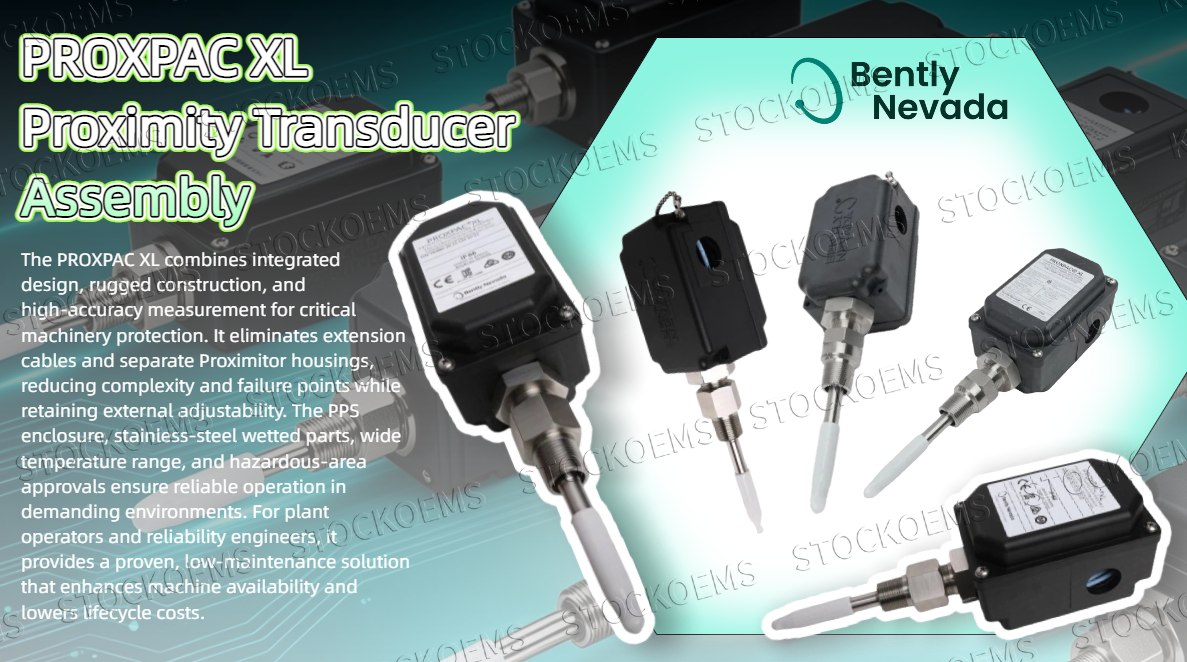
The PROXPAC XL Proximity Transducer Assembly delivers a compelling combination of integration, durability, and measurement performance for critical machinery protection and condition monitoring. By eliminating extension cables and separate Proximitor housings, it reduces system complexity and potential failure points while preserving the external adjustability that maintenance teams value. The rugged PPS enclosure, stainless-steel wetted parts, and wide operating temperature range ensure reliable operation in corrosive, humid, and high-vibration environments, while its comprehensive hazardous-area approvals and flexible configuration options support deployment across global power generation, oil and gas, and heavy industrial facilities. For plant operators and reliability engineers seeking a robust, low-maintenance proximity measurement solution, the PROXPAC XL offers a proven path to enhanced machine availability and reduced lifecycle costs.
Unified Architecture Eliminates Extension Cables and Reduces System Complexity
The PROXPAC XL Proximity Transducer Assembly from Bently Nevada represents a fundamental departure from conventional proximity probe systems by integrating the 3300 XL Proximitor sensor directly into the housing cover. This self-contained configuration obviates the need for extension cables between the probe and its associated Proximitor, as well as separate enclosures for the signal conditioner. Field wiring runs directly from the monitoring system to the PROXPAC XL assembly, thereby reducing connection points and simplifying overall system architecture. The design retains all the operational benefits of the 31000 and 32000 series housings, including external access for probe adjustment without requiring disassembly. For maintenance engineers responsible for critical rotating equipment such as steam turbines, gas turbines, centrifugal compressors, and induced-draft fans, this consolidated approach translates to reduced installation effort, fewer components to stock, and diminished susceptibility to signal degradation from connector contamination or cable damage.
Advanced PPS Enclosure Delivers Superior Environmental Robustness
The housing is moulded from glass-fibre and conductive-fibre-reinforced polyphenylene sulfide (PPS), a high-performance thermoplastic that exhibits superior strength, dimensional stability, and electrostatic dissipation compared to traditional aluminium or steel enclosures. The material also provides outstanding resistance to ultraviolet radiation, making it suitable for outdoor installations in direct sunlight. The assembly carries IP66 and Type 4X ratings, confirming its ability to withstand hose-directed water, dust ingress, and corrosive atmospheres – attributes essential for applications in chemical processing, offshore oil and gas platforms, and power generation facilities. Independent testing by BASEEFA has certified the housing to withstand 4-joule impacts at –39 °C and +115 °C, while CSA verification confirms resistance to 7-joule impacts at ambient temperature. Internal vibration isolation, achieved through extra-soft cellular silicone, protects the sensitive Proximitor electronics from machine-borne oscillations. All metallic components – including the probe case, sleeve, retaining chain, and hardware – are fabricated from AISI 303 or 304 stainless steel, providing excellent resistance to oxidation and chemical attack. The probe tip itself is constructed from PPS, ensuring compatibility with the housing material across the full thermal range.
Wide Temperature Operation and Comprehensive Certifications Enable Global Deployment
The PROXPAC XL system supports an operating temperature range of –52 °C to +100 °C for the complete assembly, while the probe alone can be exposed to temperatures up to +177 °C. The system delivers a 2 mm linear measurement range, with a recommended gap setting of 1.27 mm (50 mils) and an incremental scale factor of 7.87 V/mm (200 mV/mil) with interchangeability errors within ±5% across the linear region. Frequency response extends from DC to 10 kHz within –3 dB, accommodating measurement of subsynchronous and synchronous vibration components on high-speed turbomachinery. Cross-talk between adjacent transducers is maintained below 50 mV on shaft diameters of 50 mm or greater when properly spaced. The assembly holds multiple hazardous-area certifications, including ATEX, IECEx, and cNRTLus, covering Class I, Zone 0/1/2; Class I, II, III, Divisions 1 and 2; and dust ignition-proof (Ex ia IIIC) applications. It also complies with CE, RoHS, and maritime classification requirements. The housing is offered with various mounting threads (3/4-14 NPT, 7/8-14 UNF, M24×3) and conduit options, with probe penetration lengths configurable from 25 mm to 760 mm. Standoff adaptors are available in incremental lengths from 38 mm to 200 mm, enabling accurate positioning relative to the target surface.
Recommended Model
|
330850-50-00 |
330850-50-05 |
330850-51-CN |
|
330850-90-05 |
330851-02-000-060-50-00-00 |
330851-02-000-060-50-00-05 |
|
330851-02-000-070-90-00-05 |
330851-04-000-023-10-01-05 |
330851-05-000-040-50-01-05 |
|
330851-06-000-070-10-00-05 |
330851-06-000-070-50-00-05 |
330854-040-24-CN |
|
330854-080-24-00 |
330876-02-10-00-00 |
330876-02-10-01-00 |
|
330877-040-37-00 |
330877-080-36-00 |
330878-50-00 |
|
330878-90-00 |
330900-50-00 |
330901-10-25-10-02-00 |
|
330901-11-25-10-01-00 |
330902-00-10-10-01-05 |
330903-00-06-05-02-05 |
|
330904-00-03-70-01-CN |
330905-00-03-10-02-00 |
330905-00-05-05-02-CN |
|
330905-00-05-10-12-CN |
330905-00-07-10-02-00 |
330905-00-07-10-02-05 |
If you want to know details,please contact me without hesitate.